
How Arik Sinai changed my life
By Yehoshua Saguy
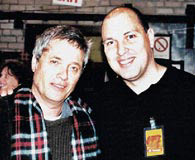
SAN FRANCISCO - David Azoulay saw
his future in the field of computers. He studied electronics
and computer engineering at the ORT school in Acre and after
his military service he returned to the school to be an
instructor there. When his brother opened a company in the
United States where he developed a program for sorting mail,
Azoulay joined him and worked as a project manager. But one
evening in 1992 his life changed entirely.
That evening he went to a performance by Israeli singer Arik Sinai
in Washington, D.C. The organization of the evening was
catastrophic. The impresario who represented Sinai in America
asked Azoulay whether he knew anyone who could organize an
artistic performance in a more professional way. "I told him
that I'd only been in the States for half a year but this
field interested me and I was prepared to
try."
Thirteen years after that evening Azoulay is the
No. 1 Israeli impresario in America. He was born in 1968 at
the maternity hospital in Nahariya, the son of a family that
immigrated to Israel from Morocco in the 1950s. The extended
family had been sent to a transit camp in Acre, and even
though it was suggested to his father that he live with his
family in Kibbutz Afikim, they did not want to be kibbutzniks
and moved to Acre. The brother who invited Azoulay to America,
16 years his elder, is Eli Argon, who had been a singer in the
Artillery Corps entertainment troupe and a reporter at Army
Radio.
Azoulay focuses on Israeli
artists, but he also organized a number of major balls in the
series of inaugural balls for President George W. Bush and
other projects. "In 1993 I brought Dudu Dotan here for
appearances in America," says Azoulay. "I was a rookie. This
was my first experience. Dudu was very enthusiastic and he
said to me: `I've already appeared abroad many times, but I've
never been greeted as well and so professionally.' We formed
an excellent connection and Dotan said to me: `Any Israeli
artist you want, I'll help you get in touch with him.' At that
time he was chairman of EMI and had a lot of power."
In his first productions he paid high tuition costs. "I lost a
lot of money and I was cheated. There are a lot of fishy
people in this business. I organized performances that were
artistic successes but when we counted up the money, the
catastrophe became clear. I went to my brother and took a loan
from him of more than half a million dollars and I learned
that it is better to do everything yourself than to get help
from certain types."
His own man
The decision to do everything himself worked perfectly. Two years
ago Azoulay organized a four-performance tour in large halls
for Rita and Rami Kleinstein. The tickets were snapped up but
American Embassy officials, who were suspicious after the
collapse of the Twin Towers, refused to issue a work permit
for Rita, who was born in Iran.
Azoulay received word
of this at his home in Washington. He contacted Benjamin
Netanyahu, who promised to help, and the American ambassador
in Israel, who said his hands were tied, and finally the
bureau of President Moshe Katsav, who was also born in Iran.
The president contacted the ambassador and was told the new
regulations even applied to Defense Minister Shaul Mofaz, and
therefore nothing could be done.
Azoulay was already
imagining the crash.
Only a few days remained before
the first performance, nearly all the tickets had been sold,
and Rita was still unable to come. "There's appropriate
insurance against such situations, but I hadn't taken it out,"
relates Azoulay. The newspapers in Israel reported that Rita
had not received a visa to the United States, and the people
who had bought tickets demanded their money back.
Azoulay decided on a final rescue move: He looked for
a line to Tom Ridge, who as head of Homeland Security was in
charge of security and visas. He recalled that at one of the
events he had organized he had seen the rabbi of the Chabad
branch in Washington, Shem-Tov Levy, embracing and engaging in
a friendly conversation with White House spokesmen Ari
Fleischer. Azoulay contacted the Chabadnik and asked him to
use his connection with Fleischer who would in turn talk to
Ridge. The rabbi promised to try, Fleischer also promised and
three hours later Azoulay heard: Ridge had arranged
everything. Rita could go to the embassy and receive a visa.
Our conversation took place last week in the theater
auditorium of Foothill College in Silicon Valley. Outside the
audience was waiting, and Rita was on the stage making the
final adjustments with the sound and lighting people. Azoulay,
unlike the rest of those present, looked calm and relaxed.
"The proprietors of the auditorium forgot to tell us
that it was undergoing renovations and that all the roads
leading to it were blocked. When the trucks came with the
equipment, we were in shock. Very quickly I found an approach
path, but it doesn't reach the auditorium. We rushed out to
the intersection, we brought a group of Mexican day workers
and all morning we worked as porters in order to get the stage
and the vast amount of equipment ready. It was only an hour
and a half ago that I managed to pop over to the hotel to
shower and change my clothes."
Throughout the
conversation Azoulay doesn't say a bad word about anyone - a
very un-Israeli characteristic. All the artists who have
appeared with him are marvelous, all his colleagues win
compliments.
Azoulay smiles and says: "I believe that
in order to succeed you don't need to say that everyone else
is unsuccessful."
© Copyright 2005 Haaretz. All rights reserved